
The Empress’s Garden: Discovering Strasbourg’s Parc de l’Orangerie
Step into the lush, royal history of Strasbourg’s oldest park. From a gift for Empress Joséphine to the triumphant return of the Alsatian stork, discover why the Parc de l'Orangerie is the true "green heart" of the European capital.
Tia
12/23/20252 min read
A Royal Retreat: The Imperial Legacy of the Orangerie
While Strasbourg is famous for its towering Gothic cathedral and bustling European institutions, just a stone's throw from the Parliament lies a 26-hectare oasis of peace: the Parc de l'Orangerie. This isn't just a park; it’s a living monument to the love (and the political power) of the Napoleonic era.
The park takes its name from a very specific gift. In 1801, during the French Revolution, 140 orange trees were confiscated from the Bouxwiller Castle. To house these exotic treasures, the city built the elegant Pavillon Joséphine. Named in honor of Empress Joséphine de Beauharnais—Napoleon Bonaparte’s wife—the pavilion and its gardens became her favorite place to stroll during her many visits to Strasbourg. Though only a few of the original orange trees remain today, the royal atmosphere of the classical French gardens still lingers in the air.
A Masterpiece of Landscape Design
What makes the Orangerie unique is its "identity crisis" in the best possible way. As you walk through, you’ll notice two distinct styles:
The French Classical Style: Symmetrical paths and geometric flowerbeds that reflect the order and elegance of the 18th century.
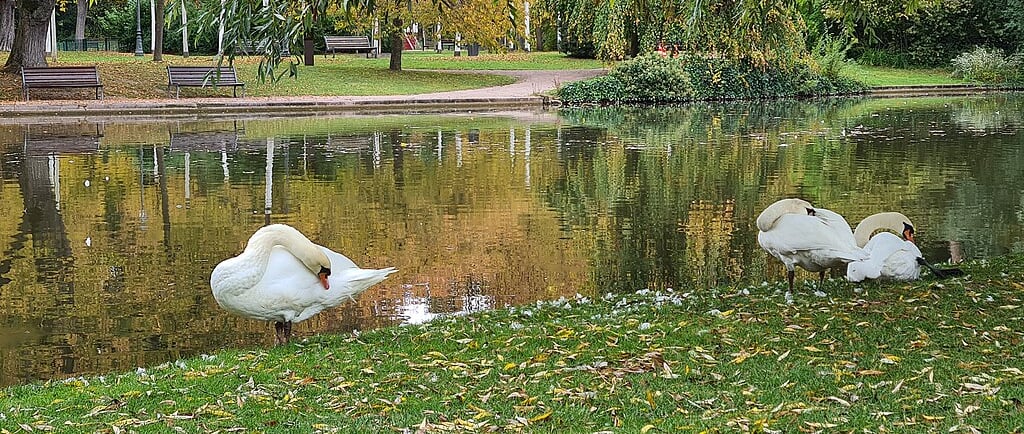
The English Garden Style: Winding alleys, hidden grottos, and a picturesque lake with a waterfall, designed in the 19th century to mimic the "wild" beauty of nature.
One of the park’s most charming surprises is the Buerehiesel. This stunning half-timbered farmhouse dates back to 1660 and was actually moved to the park piece-by-piece from a nearby village for an exhibition in 1895. Today, it stands as a gourmet restaurant and a perfect example of traditional Alsatian architecture.
The Return of the Stork
You cannot talk about the Orangerie without mentioning its most famous residents: the White Storks. In the 1970s, the stork—the beloved symbol of Alsace—was on the brink of extinction in the region. The Parc de l'Orangerie became the site of a major reintroduction program.
Today, the mission is a resounding success! Look up at the chimneys of the Josephine Pavilion or the high branches of the ancient trees, and you will see massive nests and the iconic silhouettes of these lucky birds. They have become so comfortable here that many no longer migrate, choosing to stay in their "royal" Strasbourg home all year round.
Whether you are rowing a boat on the lake or watching the storks from a park bench, the Orangerie is a reminder that Strasbourg is a city where history, royalty, and nature are beautifully intertwined.


Strasbourg on YouTube
Watch the full Strasbourg series here:
https://www.youtube.com/playlist?list=PLSlrYNJEU6ROmfDBZBfTQFHZ1SClg8oFv
https://www.youtube.com/playlist?list=PLSlrYNJEU6RM6AhVnDYWrKaXF6DIoZm66
Images: Photo by Ethan Da Silva on Unsplash,
L3 G4ll-05, CC BY-SA 4.0 <https://creativecommons.org/licenses/by-sa/4.0>, via Wikimedia Commons,
Guilhem Vellut from Annecy, France, CC BY 2.0 <https://creativecommons.org/licenses/by/2.0>, via Wikimedia Commons
Contact
Get in touch
info@storybooklivingfrance.com
© 2025. All rights reserved.
Merci!
Some links in this description are affiliate links. I may earn a small commission if you book/purchase through them at no extra cost to you.


